How Bilingualism Rewires Your Brain for Verbal Fluency
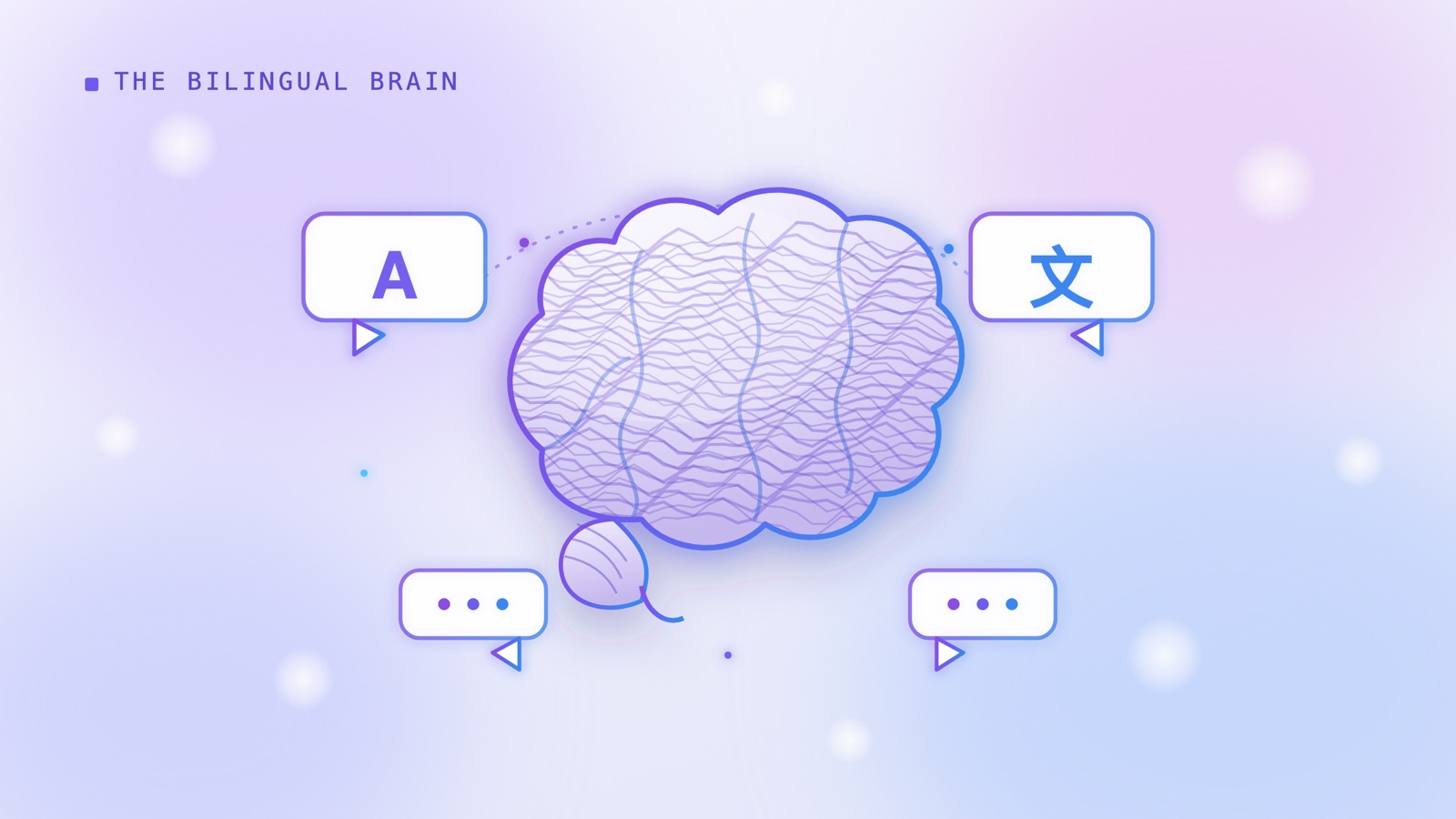
Two Languages, One Brain
Picture someone who grew up speaking Spanish at home and English at school. They're chatting with you in perfect English, then their phone rings, and without a beat — mid-breath, really — they answer in fluid Spanish, laugh at something, hang up, and turn back to you in English like nothing happened. No stumble. No "give me a second to switch gears." It looks effortless.
It isn't. Under the hood, something genuinely impressive just happened. And here's the part that surprises most people: it wasn't that they turned English off to speak Spanish. Both languages were running the whole time. The bilingual brain doesn't flip a switch. It keeps two systems humming simultaneously and quietly decides, word by word, which one gets to reach your mouth.
That constant background management turns out to be a serious cognitive workout — one that reshapes how the brain handles attention, control, and word retrieval. Which raises a question worth sitting with, even if you only speak one language: if juggling two tongues builds a stronger, more flexible mind, can you borrow that workout without spending years learning French? Short answer: yes. But first you need to see what's actually going on inside a brain that carries more than one language.
What Happens Inside a Bilingual Brain
For a long time, people assumed a bilingual person kept their two languages in separate boxes — pull open the Spanish drawer, close the English one, done. Decades of research have demolished that idea. It turns out both languages stay active at the same time, all the time, even when only one is being spoken.
Think about what that means practically. When a Spanish-English bilingual wants to say the word "table," their brain doesn't just retrieve table. It also lights up mesa. Both candidates come racing forward, and the brain has to pick one and suppress the other — in a fraction of a second, hundreds of times a conversation, without you ever noticing the contest happening.
Psycholinguists who study how we turn thoughts into speech — building on the classic model of speech production developed by Willem Levelt — describe word retrieval as a race between competing candidates. In a single-language mind, the competition is between similar words: dog versus doll versus dot. In a bilingual mind, the field of competitors is roughly doubled, because both languages throw their hats in the ring for every concept.
That sounds like a recipe for chaos. So why don't bilinguals blurt out the wrong-language word constantly? Because the brain builds a remarkably good referee. A network of control regions — heavily involving the prefrontal cortex and connected structures deep in the brain — steps in to boost the language you want and hold back the one you don't. Neuroscientists call this the "language control network," and in bilinguals it gets a lot of practice.
The key insight is this: the bilingual advantage, to the extent there is one, doesn't come from the languages themselves. It comes from the referee. The muscle that gets built isn't vocabulary — it's the machinery of selecting, inhibiting, and switching. And that machinery is the same machinery you lean on every time you reach for a word, in any language, monolingual or not. That's why this topic matters even if you'll only ever speak one.
The Executive-Control Workout
Here's a useful way to think about it. Every bilingual conversation is, in effect, a rep at the mental gym — and the muscle group is what psychologists call executive function. This is the family of high-level control skills that let you steer your own mind on purpose rather than running on autopilot.
Managing two live languages exercises several of these skills at once, over and over, for free:
- Inhibition. Every time you speak one language, you're actively suppressing the other. That's the exact same braking system you use to hold back a blurted comment, resist a distraction, or stop yourself from saying the first (wrong) word that pops up.
- Task switching. Bilinguals flip between languages depending on who they're talking to, sometimes several times a minute. Switching sets — dropping one rule set and picking up another — is one of the hardest things a brain does, and constant practice makes the transitions smoother.
- Selective attention. To know which language to use, you're continuously monitoring context: who's in the room, what was just said, what the social situation demands. That's attention being aimed and re-aimed on purpose.
- Conflict monitoring. Because both languages compete, the brain runs a constant "is there a clash here?" check and resolves it. That's the same detector that flags when your intended sentence is about to go off the rails.
- Working memory. Holding the thread of a thought steady while your brain sorts through competing words keeps the mental workspace busy and, arguably, keeps it sharp.
Notice something? None of those are language skills. They're general-purpose control skills — and they're precisely what separates someone who speaks smoothly under pressure from someone who freezes and reaches for filler words. When you understand why you forget words mid-sentence, you find the same culprits — a retrieval race, a stalled control system — that bilinguals are quietly training all day long.
That's the real headline. Bilingualism doesn't hand you better words. It hands you a better word-manager — and a stronger word-manager is the foundation of verbal fluency for everyone.
Cognitive Reserve and a More Resilient Brain
There's a longer game here too, and it's one of the most intriguing threads in the whole field of brain aging.
Researchers use the term cognitive reserve to describe the brain's ability to keep functioning well even as it accumulates wear, damage, or the slow changes of aging. Think of it like a savings account for your mind: two people can have the same amount of underlying brain change, but the one with more reserve keeps performing normally for longer, because they've got backup pathways and more efficient networks to fall back on.
Where does reserve come from? From a lifetime of mentally demanding activity — education, complex work, rich social lives, playing music, and, yes, managing more than one language. The work of Ellen Bialystok and colleagues has been especially influential here. Across a number of studies, actively bilingual older adults have tended to show the outward symptoms of age-related cognitive decline noticeably later than otherwise-similar monolinguals — not because their brains had less underlying change, but because their well-exercised control networks compensated for longer.
Be careful with this, though: bilingualism is not a vaccine against dementia, and the science here is genuinely debated, with some studies finding the effect and others not. What's much less controversial is the principle underneath it — that keeping your brain's control systems busy and challenged appears to build resilience over a lifetime. Language management is simply one effective, repeatable way to do that. We go deeper on this in our piece on the link between verbal fluency and cognitive health.
The encouraging takeaway: the same daily habit that makes you sharper in conversation now may also be quietly paying into that reserve account for later. Verbal-fluency practice is one of the rare things that's good for the you of today and the you of thirty years from now.
The Honest Trade-off
Now let's be honest, because a lot of writing on this topic oversells it. Bilingualism isn't pure upside, and pretending it is does you no favors.
Here's the trade-off. Because both languages are always active and competing, bilinguals often show a small but real naming cost. On the classic "name as many animals as you can in 60 seconds" test, bilinguals — on average, and especially in each individual language — tend to produce slightly fewer words than monolinguals, and they hit the tip-of-the-tongue state a little more often. That's the sensation where you know the word, you can almost feel its shape, but it just won't surface.
Why? A few reasons, and they're actually reassuring once you understand them:
- Divided practice. Each word in each language gets used less often than the same concept would in a monolingual, so the retrieval path is a touch less worn-in. It's not that the word is missing — it's that the trail to it sees less foot traffic.
- Cross-language competition. When you reach for mesa, table is right there elbowing in, and vice versa. More competitors means retrieval takes a hair longer.
- The cost is narrow. This shows up mostly in raw single-language naming speed. It does not mean bilinguals are worse communicators — quite the opposite in the skills that matter for real conversation.
So the picture is a genuine give-and-take: a slightly slower word-lookup in any single language, in exchange for a substantially better-trained control system that governs attention, switching, and focus. For most people that's a trade worth making many times over. And the small naming cost is exactly what targeted verbal-fluency practice is designed to shrink — you can build up those retrieval paths deliberately.
The honesty matters for another reason. If you're bilingual and you've ever felt a flicker of shame at blanking on a word in one of your languages, this is your permission slip. That blank isn't a sign your brain is weaker. It's the visible receipt of a brain doing more work, more often, than a monolingual one.
You Don't Have to Be Perfectly Fluent
Maybe you're reading this thinking, "Great for people raised bilingual, but I took two years of high-school German and can barely order a coffee." Here's the good news, and it's better than you'd expect: you don't need to be balanced, native-level, or even conversational to get the brain benefits.
The workout comes from the act of managing another language, not from mastery of it. A few things worth knowing:
- Later is not too late. The old belief that language learning only "counts" if you start as a toddler is outdated. Adults who take up a new language show measurable changes in attention and control networks — the brain stays plastic and rewires in response to the challenge at any age.
- Effortful beats fluent, in a sense. When a language is still hard for you, your control system has to work harder to produce it — which is arguably more of a workout, not less. The struggle is the point, the same way lifting a weight that's genuinely heavy is what builds muscle.
- Use it, don't just study it. Passively memorizing vocabulary lists doesn't do much. Actually switching into the language — speaking it, thinking in it, choosing it over your native tongue in the moment — is what fires the control network.
- Even a little switching helps. You don't need full conversations. Labeling objects around your house in another language, or narrating your morning in it, still exercises selection and inhibition.
The mechanism here connects directly to something monolinguals already benefit from: expanding your vocabulary gives your brain more candidates to select among and more practice at the selecting. A second language is essentially a very large, very structured vocabulary expansion that forces constant, high-stakes selection. Same engine, bigger flywheel.
Train Your Brain Like a Bilingual
So here's the payoff, and it's the practical heart of this whole piece: you can get much of the bilingual control workout without being bilingual at all. The trick is to recreate the demand — the constant selecting, inhibiting, and switching — using tasks in your own language. Try these:
- Category-switching sprints. Set a 60-second timer, but instead of naming one category, alternate two: fruit, animal, fruit, animal, out loud, no repeats. Forcing your brain to jump rule sets on every word mimics the language-switching a bilingual does all day. It's harder than it sounds — and that difficulty is the workout.
- Letter-to-category flips. Give yourself a mixed rule — "a word starting with S, then a type of vegetable, then a word starting with S." You're bouncing between phonemic and semantic retrieval, which are two different search strategies, exactly the kind of gear-changing that builds mental flexibility.
- Rename what you already know. Look at an object and try to name it three different ways: a plain word, a fancier synonym, and a short description. "Cup. Vessel. The thing I drink coffee from." You're deliberately generating competitors and choosing between them — the core bilingual move, in one language.
- Narrate against a rule. Describe what you're doing out loud, but ban your five most-used filler words, or forbid the word "thing." The banned word will keep surfacing, and holding it back trains the exact inhibition muscle bilinguals lean on constantly.
- If you have a second language, use it on purpose. Even a rusty one. Switch into it for your grocery list, your inner monologue on a walk, or the labels on things around you. You're not studying — you're switching, and switching is the ingredient that matters.
The common thread is deliberate, repeated selection under a little time pressure — the same thing a bilingual brain does thousands of times a day by necessity. Do it on purpose, consistently, and you build the same word-manager without ever leaving your native tongue.
This is the principle Flowency is built on. It packages the selecting-and-switching drills that map onto how the bilingual brain trains itself into five focused minutes a day, adapting to your level and tracking your progress so you can watch your retrieval get faster. Monolingual or bilingual, the target is the same: a quicker, calmer, more flexible word-manager — so the right word arrives when you reach for it, and the blanks get rarer.
You don't have to grow up between two languages to build a nimble brain. You just have to make your brain do the same kind of work — a few minutes at a time, most days. That's within anyone's reach.
Want a Bilingual-Style Workout in Five Minutes a Day?
Flowency turns the same selecting, inhibiting, and switching drills that train the bilingual brain into short, science-backed daily sessions — with progress tracking so you can see your fluency sharpen over time.