The Link Between Verbal Fluency and Cognitive Health
Verbal Fluency as a Cognitive Health Marker
Here's something that might catch you off guard: one of the very first things a neuropsychologist does when they want to check how your brain is doing is ask you to name as many animals as you can in 60 seconds.
Not a brain scan. Not a blood test. Not some elaborate questionnaire. Animals. In a minute. Go.
It sounds like a game you'd play on a road trip. But this deceptively simple task is one of the most powerful diagnostic tools in cognitive assessment — and understanding why can change how you think about your own brain health.
A comprehensive review in Neuropsychology Review explains the reason: verbal fluency tasks measure semantic memory, executive function, processing speed, and attention simultaneously, all in a single one-minute test. It's like a blood pressure check for your brain — quick, cheap, and remarkably informative.
When you're rattling off "dog, cat, elephant, giraffe, whale, penguin..." your brain isn't just pulling up animal names. It's strategically searching through organized knowledge (semantic memory), switching between subcategories (executive function — you might go from farm animals to ocean animals to birds), suppressing words you've already said (cognitive control), and doing all of this at speed (processing speed). That's a lot of cognitive systems firing at once.
And here's why this matters for you specifically: changes in verbal fluency performance can signal cognitive changes long before other symptoms show up. We're talking years before. That makes verbal fluency not just a diagnostic tool for clinicians, but something you can actually track and actively train to protect your brain over time. It's both a warning system and a workout, which is a pretty unusual combination.
Which Brain Regions Drive Verbal Fluency
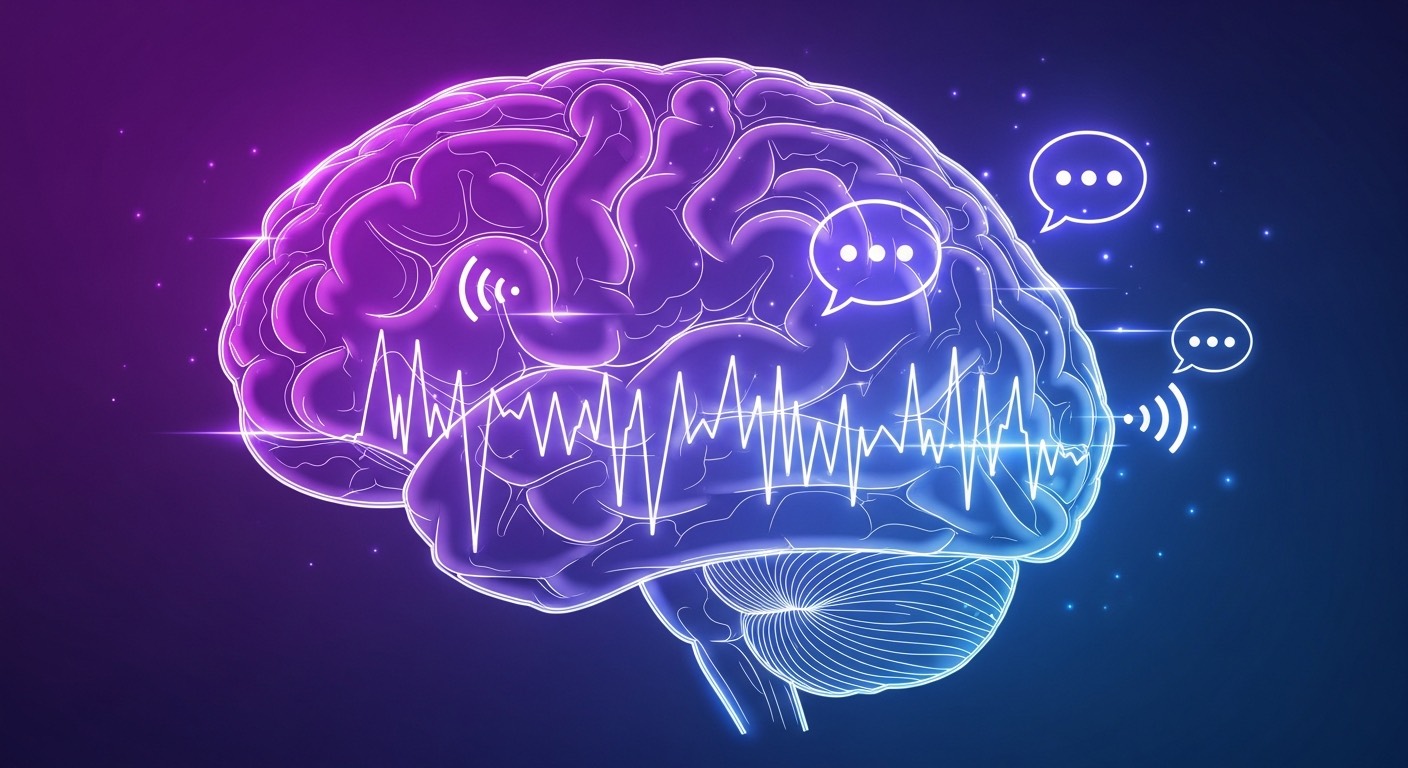
If you could peek inside your skull during a verbal fluency task — and thanks to fMRI, researchers basically can — you'd see something pretty remarkable. It's not one little area lighting up. It's more like a fireworks display spread across multiple brain regions, all firing in coordination.
Your left frontal lobe is doing the heavy strategic lifting — driving the search process, deciding where to look next, switching from one cluster of words to another. This region is especially active during phonemic fluency tasks (the "name words starting with S" type), where you're searching against your brain's natural organizational grain.
Your temporal lobes are the warehouse — they store the actual semantic knowledge, the meanings and categories that organize your entire vocabulary. When you're doing a category task, this is where your brain is browsing.
The prefrontal cortex is playing traffic cop — managing executive functions like knowing when to switch strategies (you've exhausted farm animals, time to try ocean creatures), suppressing words you've already said, and keeping you on task instead of going off on tangents.
And the anterior cingulate cortex is quality control — monitoring for errors, flagging when you're about to repeat a word, managing the cognitive control needed during rapid-fire word production.
Research published in Neuropsychologia shows that semantic and phonemic fluency tasks activate overlapping but distinct neural networks. This is actually great news, because it means practicing both types gives your brain a broader workout than focusing on just one kind.
And this multi-region activation is precisely why verbal fluency exercises are such potent cognitive medicine. A crossword puzzle mostly engages your language areas. A Sudoku mostly taxes your numerical reasoning. But a verbal fluency task? It's lighting up your frontal lobe, temporal lobe, prefrontal cortex, and anterior cingulate all at once. It's the difference between doing bicep curls and doing a full-body compound movement. More muscles involved, more benefit per minute of effort.
I think that's what makes this connection between verbal fluency and brain health so compelling. It's not just that we can use word-finding tests to check on brain health — it's that the tests themselves are a form of brain exercise. The measuring tool and the treatment are the same thing.
How Aging Affects Verbal Fluency
Let's talk about the elephant in the room (pun... sort of intended for the verbal fluency fans). Aging changes your verbal fluency. That's a fact. But the story is way more interesting — and way more hopeful — than the simple "everything declines as you get older" narrative.
Here's what actually happens: semantic fluency (the category-based stuff) stays pretty stable into your 60s before it starts to gradually decrease. Phonemic fluency (the letter-based tasks) often holds steady even longer. So the decline isn't this dramatic cliff — it's more like a very gentle slope that doesn't even start for decades.
The changes that do happen are mostly about speed, not capacity:
- Words come a little slower. They're still in there, still accessible — they just take an extra beat to surface. It's like the difference between a broadband connection and slightly throttled broadband. Same data, slightly longer load time.
- Tip-of-the-tongue moments increase. That maddening experience of knowing you know a word but not being able to produce it? Gets more frequent with age. (We've got a whole article on why this happens and what to do about it.)
- Clustering gets less efficient. When you're naming animals, a young brain might rattle off "cow, pig, horse, sheep" (farm cluster), then smoothly switch to "shark, whale, dolphin, tuna" (ocean cluster). Older brains still cluster, but the transitions between clusters slow down and the clusters themselves get smaller.
- But — and this is the wild part — your vocabulary actually gets bigger. Total vocabulary continues to grow well into your 70s. You literally know more words at 70 than at 30. It's the speed of accessing them that changes, not the number of words available.
That last point deserves a moment. It means the raw material for fluent speech keeps growing throughout your life. The challenge of aging isn't running out of words — it's maintaining the retrieval pathways to reach them efficiently.
Now, here's the important nuance: these gradual, normal changes are very different from sudden or significant drops in verbal fluency. Rapid changes can be an early marker for conditions like mild cognitive impairment or Alzheimer's disease, which is exactly why clinicians monitor verbal fluency scores closely over time. Knowing your baseline matters — and practicing verbal fluency exercises gives you both a stronger baseline and awareness of any changes.
How Verbal Exercise Protects Cognitive Health
Okay, so here's where this goes from "interesting brain facts" to "things you should actually do something about."
There's a concept in neuroscience called "cognitive reserve." The basic idea is that mentally stimulating activities build a kind of resilience buffer in your brain — extra capacity that helps you maintain normal function even as age-related changes occur. Think of it like over-engineering a bridge: even if some bolts rust, the structure holds because it was built with excess capacity.
A landmark report by The Lancet Commission on Dementia identified education and cognitive engagement as significant modifiable risk factors for dementia. That word "modifiable" is key — it means this is something you can actually influence, unlike genetics or age. Regular verbal and linguistic activity falls squarely into this category.
Here's what happens in your brain when you do verbal fluency exercises regularly:
You maintain and strengthen existing pathways. Every time you retrieve a word during practice, you reinforce the neural connection that delivered it. It's like walking a trail through the woods — each trip keeps the path clear and easy to follow. Stop walking it, and the brush grows back.
You build backup routes. When you practice accessing words in different ways — by category, by first letter, by association, by meaning — you create multiple pathways to reach the same word. This redundancy is hugely important. If one pathway weakens with age, your brain has alternative routes. It's the neural equivalent of knowing three different roads to work.
You keep your processing speed up. Just like regular cardio maintains your cardiovascular fitness, regular cognitive exercise maintains your processing speed. The brain is remarkably use-dependent — the skills you practice stay sharp, and the ones you neglect fade.
You exercise your executive function. The strategic components of verbal fluency tasks — knowing when to switch categories, suppressing already-used words, managing your search strategy — keep your prefrontal cortex engaged and healthy. This is the brain region most vulnerable to age-related decline, and also the one most responsive to exercise.
What makes verbal fluency exercises uniquely valuable is that they're not just training language — they're training language, memory, attention, speed, and executive function all at once. It's hard to find another single activity that engages so many cognitive systems simultaneously.
Daily Practices for Brain and Language Health
I want to be practical here, because knowing that verbal exercise protects your brain is useless if you don't actually do anything about it. The good news? The bar is lower than you think. You don't need to become a competitive Scrabble player or read the dictionary for fun. (Though if that's your thing, more power to you.)
Five minutes of verbal fluency practice. That's the minimum effective dose. Category naming, letter drills, synonym challenges — any of the science-backed exercises will do. An app like Flowency structures this for you, but a kitchen timer and your own voice work just as well. The point is consistency, not perfection.
Have real conversations. This one sounds obvious, but think about how much of your daily communication is actually... texting. Emailing. Scrolling. Meaningful, in-person (or at least voice-to-voice) conversation is one of the most complex cognitive tasks humans perform. Your brain is simultaneously processing language input, planning responses, reading social cues, managing turn-taking, and retrieving vocabulary — all in real time. It's an extraordinary workout. Prioritize it. Call someone instead of texting. Have dinner without phones on the table. The cognitive benefits of genuine conversation are massive and underappreciated.
Read and absorb new words. Every new word you learn doesn't just add one node to your brain's word network — it creates multiple new connections between existing words. It's exponential enrichment. Read broadly. Pay attention to unfamiliar words. Try to use one new word in conversation per week. It's a small investment with compounding returns.
Write things down. Writing engages many of the same language networks as speaking, but it adds the dimension of deliberate organization and word selection. Journal entries, emails you actually think about, even social media posts where you try to express something precisely — all of these count as cognitive exercise.
Learn something new. A new language, a musical instrument, a craft, a subject you've never studied. Novel learning creates fresh neural pathways and strengthens cognitive flexibility — the ability to think in new ways and adapt to new demands. You don't have to master anything. The act of learning itself is the benefit.
One thing I find really compelling about this whole area of research: the benefits compound over time. You're not just maintaining a static level of function — you're building capacity. Each year of consistent verbal practice adds another layer to your cognitive reserve. Someone who's been reading, conversing, and doing word exercises for twenty years has a substantially different brain than someone who's spent those same twenty years in passive consumption mode. The differences might not show up at age 40, but they become increasingly apparent with each passing decade.
And there's something deeply satisfying about the idea that one of the best things you can do for your long-term brain health is also one of the most enjoyable: talk to people. Read interesting things. Play with language. Learn new words. Tell stories. These aren't chores — they're some of the richest experiences human life has to offer. The fact that they also happen to be powerful cognitive medicine is just a bonus.
Here's what I want you to take away from all of this: your brain responds to exercise the same way your body does. Consistency beats intensity. Short daily sessions beat occasional marathons. And it's never too late to start — or too early. Whether you're 25 and want to stay sharp for decades, or 65 and want to maintain what you've got, the prescription is the same: use your words. Use them often. Use them in different ways. Your future brain will thank you for it.
Ready to Improve Your Verbal Fluency?
Flowency helps you build stronger verbal fluency with just 5 minutes of science-backed exercises per day. Track your progress and watch your communication skills grow.